
TVS Test for Female: Why It’s Done and What It Shows
Blog Overview:
In this blog, we explain everything about the TVS test for female, including what it is, why doctors recommend it, how the procedure works, what it can detect, and what your results might mean. If you have been told you need a TVS test and are not sure what to expect, this guide will help you feel informed and prepared.
When a doctor recommends a TVS test, it can feel a little overwhelming especially if you have never had one before. The name sounds technical. The idea of an internal scan can feel uncomfortable. And you might not be entirely sure why it is being suggested in the first place.
This blog is here to clear all of that up. The TVS test for female is one of the most commonly performed and most useful diagnostic tools in women’s health and understanding what it involves makes the whole experience much less stressful.
What Is the TVS Test for Female?
TVS stands for Transvaginal Sonography or Transvaginal Ultrasound. It is an imaging test that uses sound waves to create pictures of the female reproductive organs from inside the body.
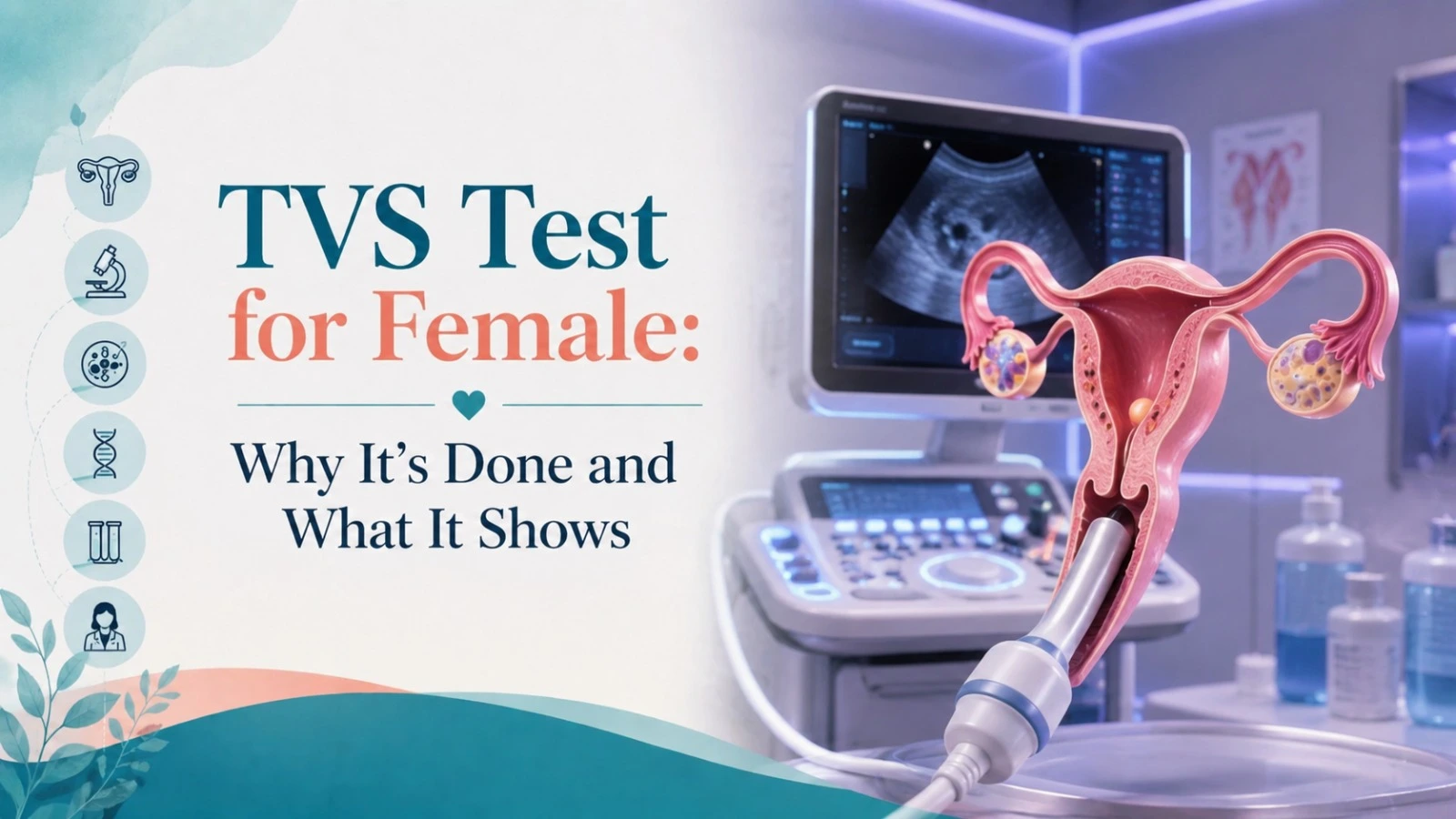
During a TVS test for female, a small, thin wand, called a transducer, is gently inserted into the vagina. This wand sends out sound waves that bounce off the pelvic organs and create detailed images on a screen. No radiation is used at any point. It is completely safe.
The reason a TVS is done internally rather than through the abdomen is because it gives a much clearer and more detailed picture. The transducer is closer to the organs being examined, which means the images are sharper and more accurate than a standard abdominal ultrasound.
Why Is the TVS Test for Female Recommended?
There are many reasons a doctor might recommend a TVS test for female. Here are the most common ones:
- Investigating pelvic pain — to find the cause of lower abdominal or pelvic pain
- Abnormal uterine bleeding — including heavy periods, bleeding between periods, or bleeding after menopause
- Checking for fibroids — non-cancerous growths in the uterus wall
- Detecting ovarian cysts — fluid-filled sacs on the ovaries
- Diagnosing endometriosis — a condition where tissue similar to the uterine lining grows outside the uterus
- Confirming early pregnancy — TVS can detect a heartbeat earlier than an abdominal scan
- Checking for ectopic pregnancy — when a pregnancy develops outside the uterus, which needs urgent attention
- Fertility evaluation — checking ovarian reserve, follicle count, and uterine health before or during IVF
- Monitoring IVF cycles — tracking follicle growth and checking uterine lining during treatment
- Checking for PMOS (previously known as PCOS, now renamed in 2026) — TVS helps count ovarian follicles which is important for diagnosis
What Can the TVS Test Detect?
The TVS test for female gives your doctor a very clear view of the following:
| What Is Examined | What Can Be Found |
| Uterus | Fibroids, polyps, structural abnormalities |
| Ovaries | Cysts, follicle count, signs of PMOS |
| Fallopian tubes | Blockages, ectopic pregnancy |
| Endometrium (uterine lining) | Thickness, abnormal growths |
| Cervix | Structural issues |
| Early pregnancy | Heartbeat, gestational sac, fetal development |
How Is the TVS Test for Female Done — Step by Step
Many women feel anxious about this test simply because they do not know what to expect. Here is a simple and clear walkthrough:
Before the test
You will usually be asked to empty your bladder beforehand unlike an abdominal ultrasound, which requires a full bladder. You will be asked to undress from the waist down and will be given a sheet for privacy.
During the test
You will lie on an examination table, typically with your knees bent. The transducer which is about the size of a large tampon is covered with a disposable protective sheath and a small amount of gel to make insertion comfortable. The doctor or sonographer will gently insert it into the vagina. You may feel a little pressure, but it should not be painful. If you feel discomfort at any point, you can let the technician know immediately.
The transducer is moved gently to get images from different angles. The whole procedure usually takes between 15 to 30 minutes.
After the test
You can go back to your normal activities straight away. There is no recovery time needed. The gel is cleaned up and you are done.
⚠️ Important Note: A TVS test should always be performed by a trained medical professional. If you have been advised to get one, please do not delay or try to self-diagnose based on internet information alone. Always consult a qualified gynaecologist or fertility specialist who can interpret your results in the context of your overall health and medical history.
Is the TVS Test Painful?
This is one of the most common questions women ask and the honest answer is that most women feel mild pressure or slight discomfort, but not pain.
Because the transducer is designed to be narrow and is well-lubricated, insertion is usually very gentle. The discomfort is typically minimal and brief. Women who have certain conditions like vaginismus or severe pelvic pain may find it more uncomfortable, and it is always worth letting your doctor know beforehand so they can take extra care.
If you are very anxious about the test, it is completely fine to say so. A good doctor will take the time to explain what is happening and go at a pace that feels manageable for you.
TVS Test for Female During IVF & Why It Is So Important
The TVS test for female is particularly central to IVF treatment. In fact, it is used multiple times throughout a single IVF cycle.
Here is how it is used during IVF:
- Before the cycle starts — to count antral follicles (small resting follicles in the ovaries), which helps the doctor plan medication doses
- During stimulation — to monitor how follicles are growing in response to medication, usually every 2 to 3 days
- Before egg retrieval — to confirm the follicles are ready and guide the retrieval procedure
- Before embryo transfer — to check the thickness and condition of the uterine lining
The TVS test essentially acts as the doctor’s eyes throughout the IVF process. Without it, accurate monitoring of the cycle would not be possible.
TVS vs Abdominal Ultrasound & What Is the Difference?
Many women wonder why a TVS is recommended instead of a regular abdominal ultrasound. Here is a simple comparison:
| Feature | TVS (Transvaginal) | Abdominal Ultrasound |
| Where the probe is placed | Inside the vagina | On the abdomen |
| Image clarity | Much clearer and it is closer to organs | Less detail |
| Bladder requirement | Empty bladder needed | Full bladder needed |
| Best for | Pelvic organs, early pregnancy, IVF | General overview, later pregnancy |
For diagnosing conditions related to the uterus, ovaries, and fertility — the TVS is almost always the preferred and more accurate option.
Who Should Get a TVS Test?
Here are situations where a TVS test for female is commonly recommended:
- You’ve been experiencing pelvic pain for more than a few weeks
- You have irregular, heavy, or unexplained uterine bleeding
- You are trying to conceive and have not been successful after 6 to 12 months
- You’re about to start IVF or fertility treatment
- You have been diagnosed with or suspected to have PMOS, endometriosis, or fibroids
- You have had a positive pregnancy test and want to confirm it is in the right location
- You’re above 35 and want a routine reproductive health check
Final Thoughts
The TVS test for female is one of the safest, most informative, and most commonly used tools in women’s reproductive health. It uses no radiation, takes under 30 minutes, and gives your doctor a very detailed view of your pelvic organs that simply cannot be matched by an external scan.
If you have been recommended for a TVS test for female then there is no need to feel anxious. Understanding what it involves, why it is being done, and what it can show makes the experience much more manageable. And the information it gives your doctor is genuinely valuable in getting you the right diagnosis and the right treatment.
Always speak to a qualified specialist before, during, and after your test so your results are properly understood and your care plan is right for you.
Frequently asked questions (FAQs)
- Is the TVS test for female painful?
Most women feel mild pressure or slight discomfort. The procedure is designed to be as gentle as possible. Let your doctor or technician know if you feel uncomfortable at any point.
2. Do I need a full bladder for a TVS test?
Unlike an abdominal ultrasound, you are usually asked to empty your bladder before a TVS test.
3. How long does a TVS test take?
Usually between 15 to 30 minutes. You can return to normal activities immediately after.
4. Can a TVS test confirm pregnancy?
Yes. A TVS can detect a gestational sac and heartbeat earlier than an abdominal scan making it very useful in early pregnancy.
5. How many times is a TVS test done during IVF?
Multiple times typically every 2 to 3 days during the stimulation phase, and again before egg retrieval and embryo transfer.
6. Is radiation used in a TVS test?
No. TVS uses sound waves only and no radiation is involved. It is completely safe.